
Removing White Rings
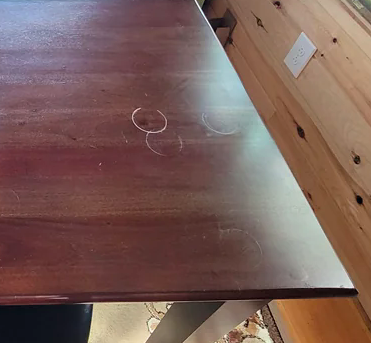
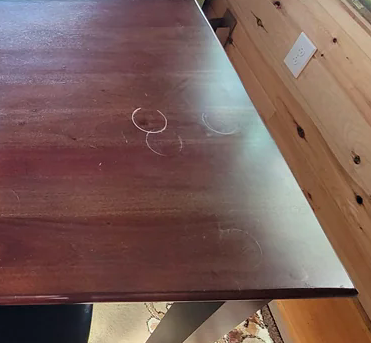
Water rings can often be removed, the success depending on the condition of the finish, how long the ring has been there, and how deep into the finish the water has penetrated.
Care must be taken when attempting this procedure as you are using alcohol to fix a problem, and alcohol is also the solvent used to liquefy this particular finish. You can create unevenness in the finish if you 'work' too hard. The trick is to start off very cautiously and observe how the finish responds.
Here is the procedure:
Get a small soft cotton rag and form it into a small pad, such that there are no folds on the working surface. Lightly dampen the working surface of the cloth with denatured alcohol - start with very little. Wipe the effected area lightly in a motion like you landing a airplane on the finish and taking off again - just kissing the surface. Do not rub hard. You will have the cloth dampened enough with alcohol that it leaves the appearance of a comet's tail trailing as you wipe. The comet's tail is caused by the alcohol evaporating.
If you do not see the comet's tail you can add more alcohol, but pay close attention to what is happening. If you notice that your pad begins to stick upon 'landing', stop or move to another area of the ring. You don't want the pad to stick as that indicates that you are beginning to dissolve the finish.
If you find you are not affecting the ring, it may be deep in the finish and you should probably consult a professional refinisher.
If you remove the white ring and you see a dark ring in it's place, that means the wood has been damaged.
This may need a professional refinisher also.
Get in touch for inquiries and support:
©ShellacShack.com 2025. All rights reserved.
(541)332-8003
Terms and Conditions
Because the quality of shellac flakes is affected by moisture, and we cannot control the care with which it is handled and stored after it has reached the customer, we limit our guarantee to 50 days - 7 weeks from the date of shipping.
Shellac Shack recommends that you keep the zip-lock bag sealed and that you store the flakes in a low humidity area. Some folks like to keep their flakes in the refridgerator where the humidity is low. This will also keep the flakes from blocking ( sticking together ) on hot summer days, although blocking will not damage the quality of shellac flakes. It's good to remember that on warm humid day there is much more water in the air ( per volume ) than on a cool rainy day.
If you have any questions, please give us a call.